

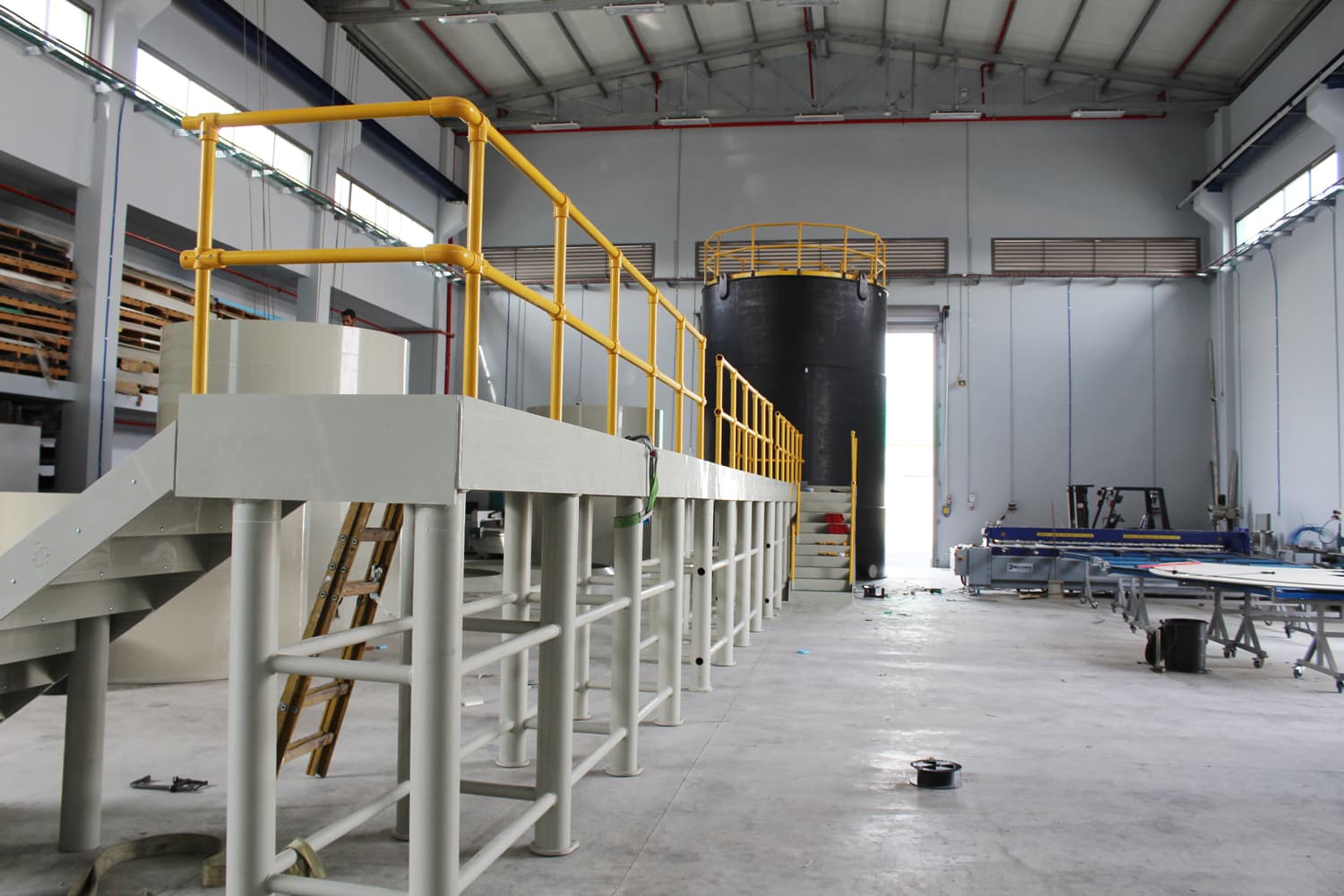


PP withstands high temperatures (up to 100 degrees Celsius) and is resistant to acids and bases. HDPE excels in cold environments (down to minus 50) and offers superior flexibility. PVC is cost-effective for cold water and sewage with built-in fire resistance, PVDF withstands extreme chemicals like HF and halogens, and FRP delivers structural strength with no size limitations. The choice between them depends on three key factors: operating temperature, type of chemicals in contact, and required tank size.
This guide is based on over thirty years of experience manufacturing tanks and piping from all five materials, and provides a practical comparison designed to help process engineers, procurement managers and facility planners make an informed decision. The technical data is based on manufacturer specifications and accumulated field experience in projects across the chemical, petrochemical, water and wastewater, marine aquaculture, food and pharmaceutical industries.
The Five Materials at a Glance
This guide is intended for those who are already familiar with the materials and are deciding between them. Here is a summary of the key differences - for an in-depth guide on each material, click the link:
- PP (Polypropylene) - The lightest option, continuous use up to 100 degrees Celsius, preferred for acids and bases
- HDPE (High-Density Polyethylene) - The most flexible, down to minus 50, resistant to oxidizers
- PVC (Polyvinyl Chloride) - The most rigid, self-extinguishing, cost-effective for cold water and sewage
- PVDF (Polyvinylidene Fluoride) - The widest temperature range (-40 to 150), the only option for HF and halogens, 5-8 times more expensive
- FRP (Fiberglass Reinforced Plastic) - The strongest mechanically, no size limitations, resin-dependent
Comprehensive Comparison Table - Physical and Mechanical Properties
| Property | PP | HDPE | PVC | PVDF | FRP (Vinyl Ester) |
|---|---|---|---|---|---|
| Density (g/cm3) | 0.90-0.92 | 0.94-0.97 | 1.30-1.45 | 1.77-1.78 | 1.5-1.8 |
| Melting Point (C) | 160-170 | 130-137 | Decomposes (~100-260) | 170-177 | Not applicable (thermoset) |
| Continuous Service Temp. (C) | 0 to 100 | -50 to 80 | 0 to 60 | -40 to 150 | -40 to 120 |
| Max Short-Term Temp. (C) | Up to 140 | Up to 120 | Up to 80 | Above 150 | Up to 160 (Novolac) |
| Tensile Strength (MPa) | 25-40 | 21-37 | 40-60 | 50-60 | 100-150 |
| Elastic Modulus (GPa) | 1.0-1.5 | 0.8-1.2 | 2.5-4.0 | 2.0-2.5 | 10-14 |
| Flexibility / Elongation (%) | 100-300 | 100-1,000 | 20-80 | 300-400 | 1-3 |
| Hardness (Shore D) | 55-65 | 60-70 | 75-85 | 75-80 | 40-55 (Barcol) |
| UV Resistance | Moderate (requires stabilizer) | Good (with stabilizer) | Moderate | Excellent | Excellent (with gel coat) |
| Fire Resistance | Flammable | Flammable | Self-extinguishing | Self-extinguishing (LOI 44%) | Resin-dependent (510A is FR) |
| Heat Welding | Yes | Yes | Yes (limited) | Yes | No (lamination) |
Important note: The values in this table represent typical ranges for standard commercial grades. When designing a specific system, verify the data with the raw material manufacturer and conduct compatibility tests for your actual operating conditions.
Chemical Resistance Comparison - The Decisive Factor in Material Selection
Chemical resistance is usually the deciding factor when choosing a material for an industrial tank or piping system. The following table summarizes each material's resistance to the main chemical groups used in industry:
| Chemical Group | PP | HDPE | PVC | PVDF | FRP (Vinyl Ester) |
|---|---|---|---|---|---|
| Dilute Inorganic Acids | Excellent | Excellent | Good | Excellent | Excellent |
| Concentrated Inorganic Acids | Good (not HNO3) | Good | Limited | Excellent | Good (Vinyl Ester Novolac) |
| Hydrofluoric Acid (HF) | Not suitable | Good | Not suitable | Excellent | Not suitable (attacks fibers) |
| Bases (NaOH, KOH) | Excellent | Excellent | Good | Excellent (up to pH 13.5) | Excellent |
| Halogens (Chlorine, Bromine) | Not suitable | Limited | Limited | Excellent | Good |
| Oxidizing Agents | Not suitable | Good | Limited | Excellent | Good |
| Salts and Aqueous Solutions | Excellent | Excellent | Excellent | Excellent | Excellent |
| Alcohols | Excellent | Excellent | Good | Excellent | Good |
| Aromatic Solvents | Limited | Limited | Not suitable | Good | Limited |
| Chlorinated Solvents | Not suitable | Not suitable | Not suitable | Good | Moderate |
| Ketones (Acetone) | Limited | Good | Not suitable | Not suitable | Limited |
| Oils and Fuels | Good | Limited | Good | Good | Good |
Please note: This table provides a general overview. Actual chemical resistance depends on concentration, temperature, and exposure time. Contact our engineering team for a specific compatibility assessment for the chemicals you are working with.
When to Choose Each Material - A Practical Guide by Application
Choose PP When Working with Acids and Bases at Elevated Temperatures
PP is the preferred choice when broad chemical resistance is needed at temperatures between 60 and 100 degrees Celsius. The lightest of the five materials, it is cost-effective and suitable for most chemical industry applications. Complete PP guide | PP tanks | PP piping
When not to choose PP: Below zero degrees Celsius (becomes brittle), against strong oxidizers or halogens, or when extreme flexibility is required.
Choose HDPE When You Need Flexibility and Cold Resistance
HDPE excels in flexibility (elongation up to 1,000%) and resistance at freezing temperatures down to minus 50. More resistant to oxidizers than PP. The natural choice for underground piping and outdoor installations with temperature fluctuations. Complete HDPE guide | HDPE tanks | HDPE piping
When not to choose HDPE: Above 80 degrees Celsius continuous, when high rigidity is needed, or against aromatic solvents and fuels over extended periods.
Choose PVC for Cold Water Systems, Sewage and Fire Safety Requirements
PVC is the most rigid and cost-effective option, with built-in fire resistance (self-extinguishing). Suitable for cold water, sewage and drainage systems at temperatures up to 60 degrees Celsius. Complete PVC guide | PVC tanks | PVC piping
When not to choose PVC: Above 60 degrees Celsius, when flexibility is needed, or against organic solvents (acetone, ketones, aromatic solvents).
Choose PVDF When Chemicals Are Extreme or Temperatures Are High
PVDF is the only material suitable for HF, halogens and strong oxidizers, with a range of minus 40 to 150 degrees Celsius. Intended for applications where other materials cannot meet the requirements. Cost is 5-8 times higher than PP. Complete PVDF guide | PVDF tanks
When not to choose PVDF: When there is no real need for its extreme resistance (unnecessary cost), or against ketones (acetone), strong amines and polar solvents such as DMF and NMP.
Choose FRP When You Need High Structural Strength and Large Tanks
FRP offers mechanical strength 3-4 times greater than PP and HDPE, with no size limitations. Chemical resistance depends on the resin: polyester for mild applications, vinyl ester for chemicals, novolac for high temperatures. Lighter than steel and corrosion-free. Complete FRP guide
When not to choose FRP: Against HF (attacks glass fibers), when flexibility is required, when field welding is needed (FRP is joined by lamination), or when PP/HDPE provide a sufficient solution.
Economic Comparison - Total Life Cycle Cost
Choosing a material based solely on purchase price is a common mistake. The true cost of a tank or piping system includes purchase price, installation cost, ongoing maintenance and replacement cost over the facility's lifetime. The following table presents a relative comparison:
| Criterion | PP | HDPE | PVC | PVDF | FRP |
|---|---|---|---|---|---|
| Raw Material Cost | Low | Low | Low | Very High | Medium-High |
| Manufacturing Cost | Medium | Medium | Low | High | High |
| Installation Cost | Medium (welding) | Medium (welding) | Low (bonding) | High (specialized welding) | Medium |
| Annual Maintenance | Minimal | Minimal | Minimal | Minimal | Minimal |
| Expected Service Life | 25-30 years | 30+ years | 25-30 years | 30+ years | 30+ years |
| Life Cycle Cost | Low | Low | Low | High | Medium |
When PVDF seems too expensive, there is an intermediate solution: an FRP tank with an internal PVDF liner. A thin PVDF layer (2-3 mm) provides the chemical barrier, while the FRP shell provides structural strength. This solution enables tanks with volumes up to 200,000 liters at a significantly lower cost than a full PVDF tank.
Standards and Quality Control
Manufacturing tanks and piping from thermoplastic materials requires compliance with international standards that ensure safety and quality:
DVS 2205 Standard - The leading German standard for the design, manufacturing and quality control of tanks and process equipment made from thermoplastic materials (PP, HDPE, PVC, PVDF). The standard defines requirements for wall thickness, welds, connections and quality testing. Every tank we manufacture to this standard undergoes pressure testing, thickness measurement and full documentation of the manufacturing process.
BS 4994 Standard - The British standard for the design and manufacturing of FRP tanks. It defines requirements for resin selection, manufacturing methods, Barcol hardness testing to verify full cure, and leak testing.
ISO 4427 Standard - The international standard for HDPE piping in water infrastructure. It defines material grades (PE80, PE100), working pressures and minimum service life requirements of 50 years.
Decision Tree - Seven Questions for Choosing the Right Material
To simplify the selection process, here are seven questions every engineer should ask:
1. What is the temperature range?
Below zero - HDPE (down to -50) or PVDF (down to -40). Between 0 and 60 - all materials are suitable. Between 60 and 100 - PP, PVDF or FRP. Above 100 - PVDF or FRP with vinyl ester novolac resin.
2. Which chemicals are in contact?
Standard acids and bases - PP is the most cost-effective. Oxidizing agents - HDPE or PVDF. Halogens or HF - PVDF only. Organic solvents - check specific compatibility.
3. What size is required?
Up to 50 m3 - all materials. Above 50 m3 - FRP or HDPE. Above 200 m3 - FRP is the practical choice.
4. Is fire resistance required?
Yes - PVC, PVDF, or FRP with fire-retardant resin (DERAKANE 510A).
5. Is the installation outdoors?
UV exposure and temperature fluctuations - HDPE or FRP with UV-protected gel coat.
6. What are the weight constraints?
Weight limitations on a tank roof or existing platform - PP (lightest) or FRP (light and strong).
7. What is the budget?
Limited budget - PP or HDPE. Mid-range budget - FRP. Open budget for critical applications - PVDF. Intermediate solution - FRP with PVDF liner.
Combined Solutions - When One Material Is Not Enough
A single material does not always provide a complete solution for all project requirements. At Plast Hen, we also manufacture combined solutions:
FRP tank with PVDF liner - An internal PVDF layer for extreme chemical resistance, with an external FRP shell for structural strength. Enables large tanks with HF and halogen resistance at a lower cost than a full PVDF tank.
FRP tank with PP liner - A cost-effective combination of chemical resistance and structural strength. Suitable for large volumes with acids and bases at moderate concentrations.
PP/HDPE piping with FRP reinforcement - For long piping runs requiring additional structural strength or resistance to high pressures.
From the Field - How Material Selection Looks in Practice
In a project we completed for a chemical plant in southern Israel, the client needed to store 60% concentration sulfuric acid at a working temperature of 70 degrees Celsius. Their initial choice was a PVDF tank, but after thorough engineering analysis we selected FRP with vinyl ester resin (ETERSET 2962) and a 4 mm internal liner. The solution provided the required chemical resistance at a significantly lower cost, with two tanks at 40 and 30 m3 capacity.
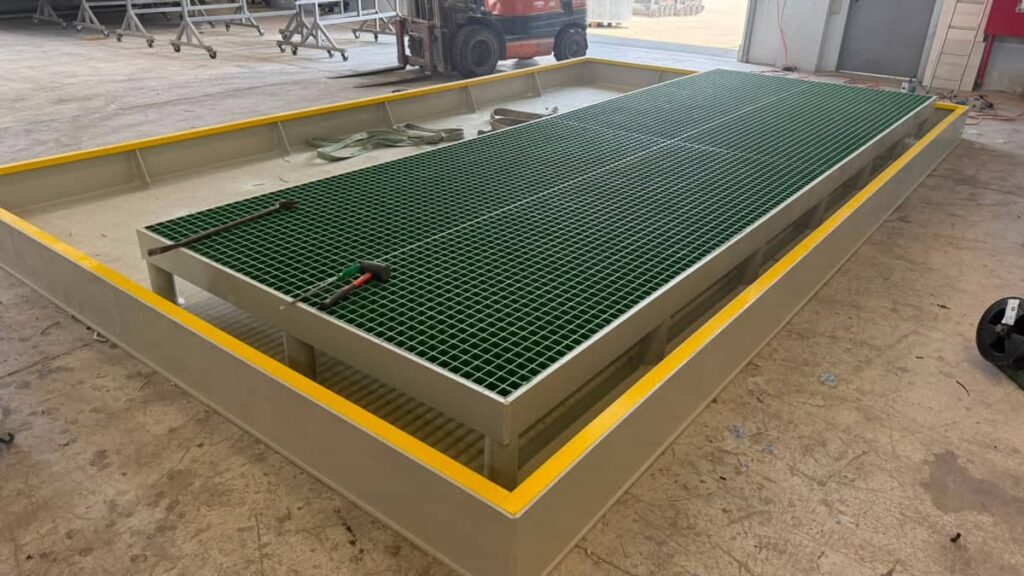
In another project, for a water treatment facility in the Negev, outdoor containment basins were needed with exposure to sun and temperatures ranging from minus 5 in winter to 45 degrees Celsius in summer. Here HDPE was the right choice - its flexibility prevents cracking in cold weather, UV resistance with stabilizer protects against sun damage, and the competitive cost made it possible to cover a large area within a reasonable budget.
These examples illustrate an important point: there is no single "best" material. There is a material that best suits the specific operating conditions of each project. And sometimes the right solution is a combination of two materials, such as FRP with a thermoplastic liner.