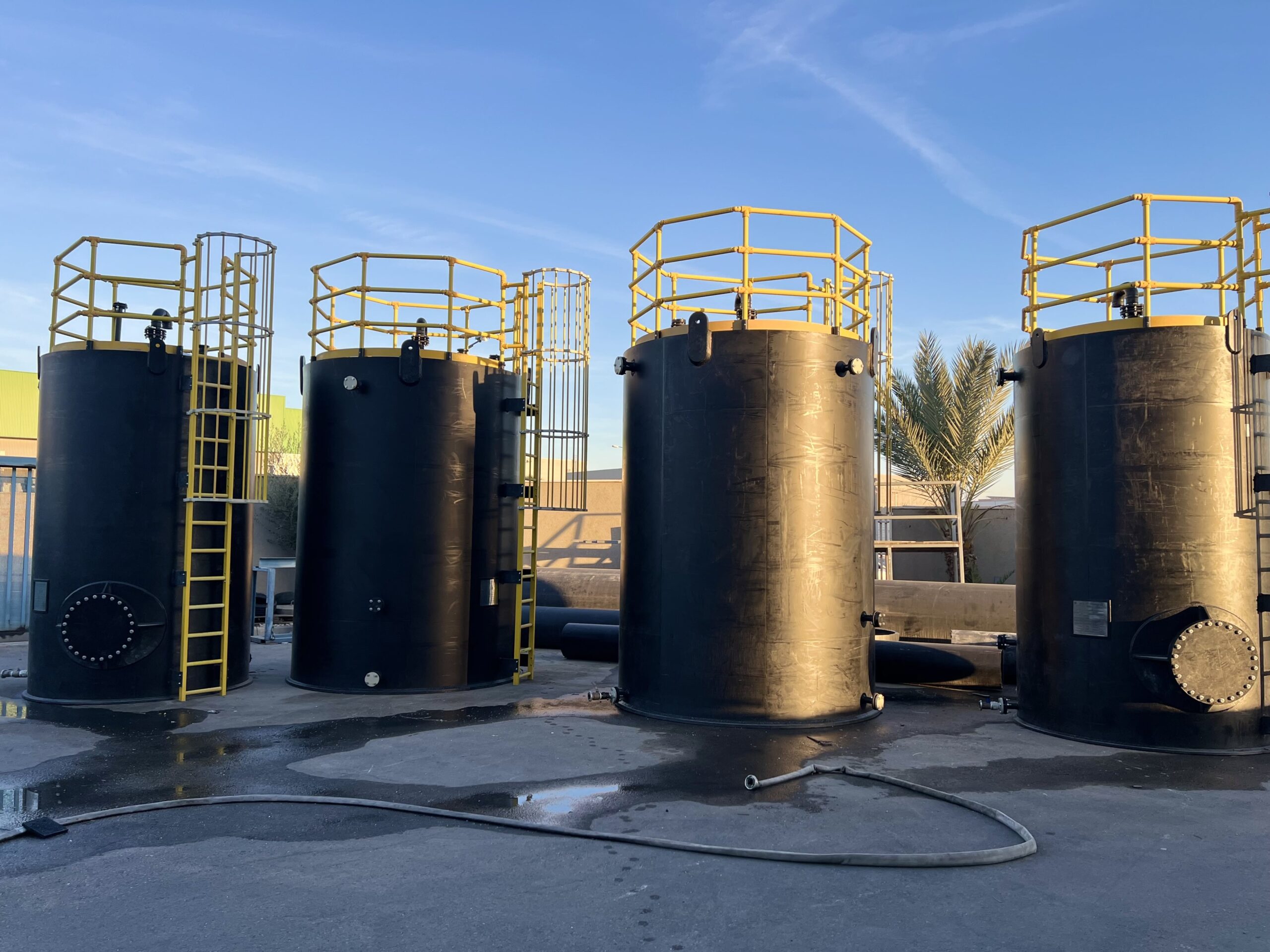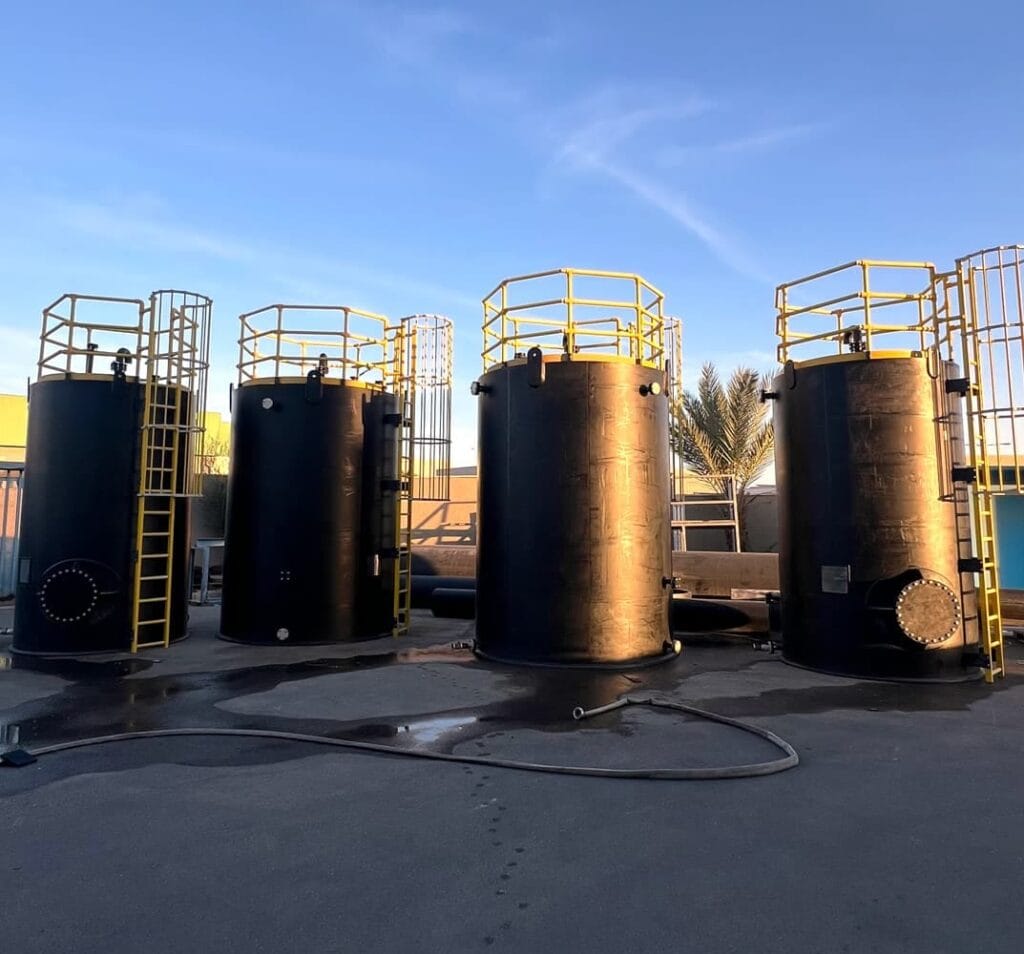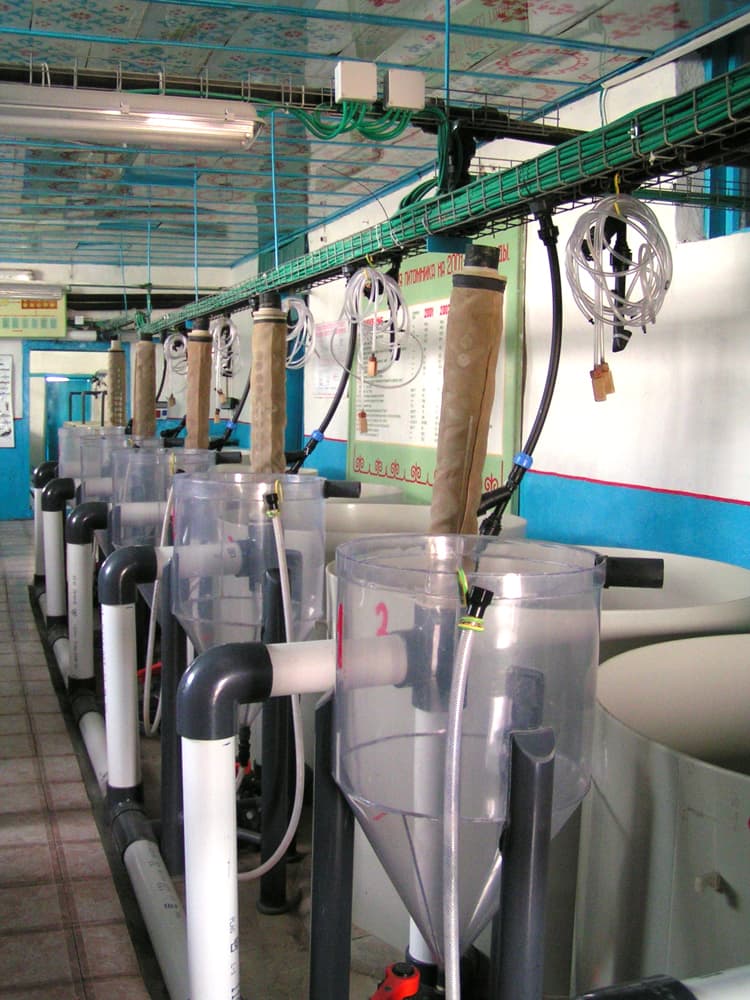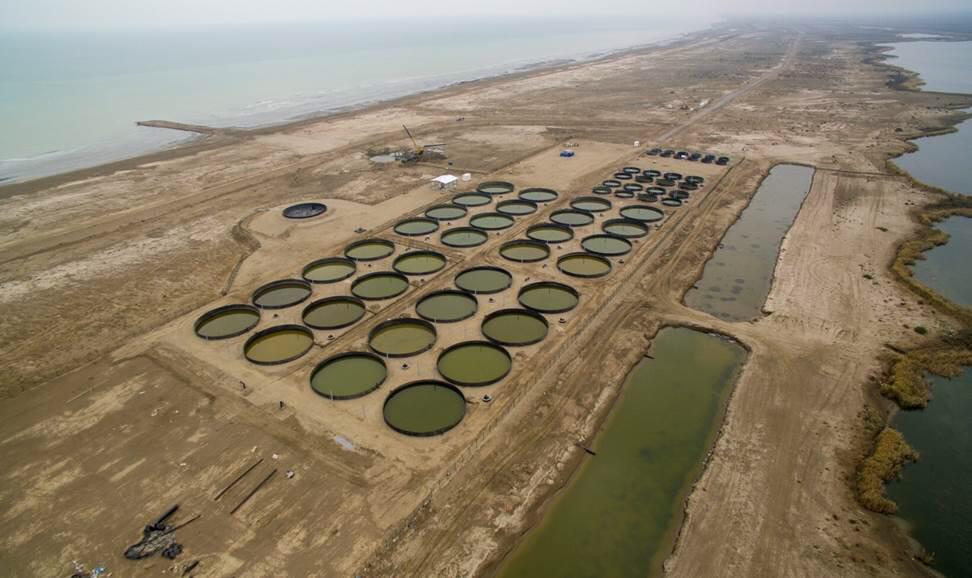


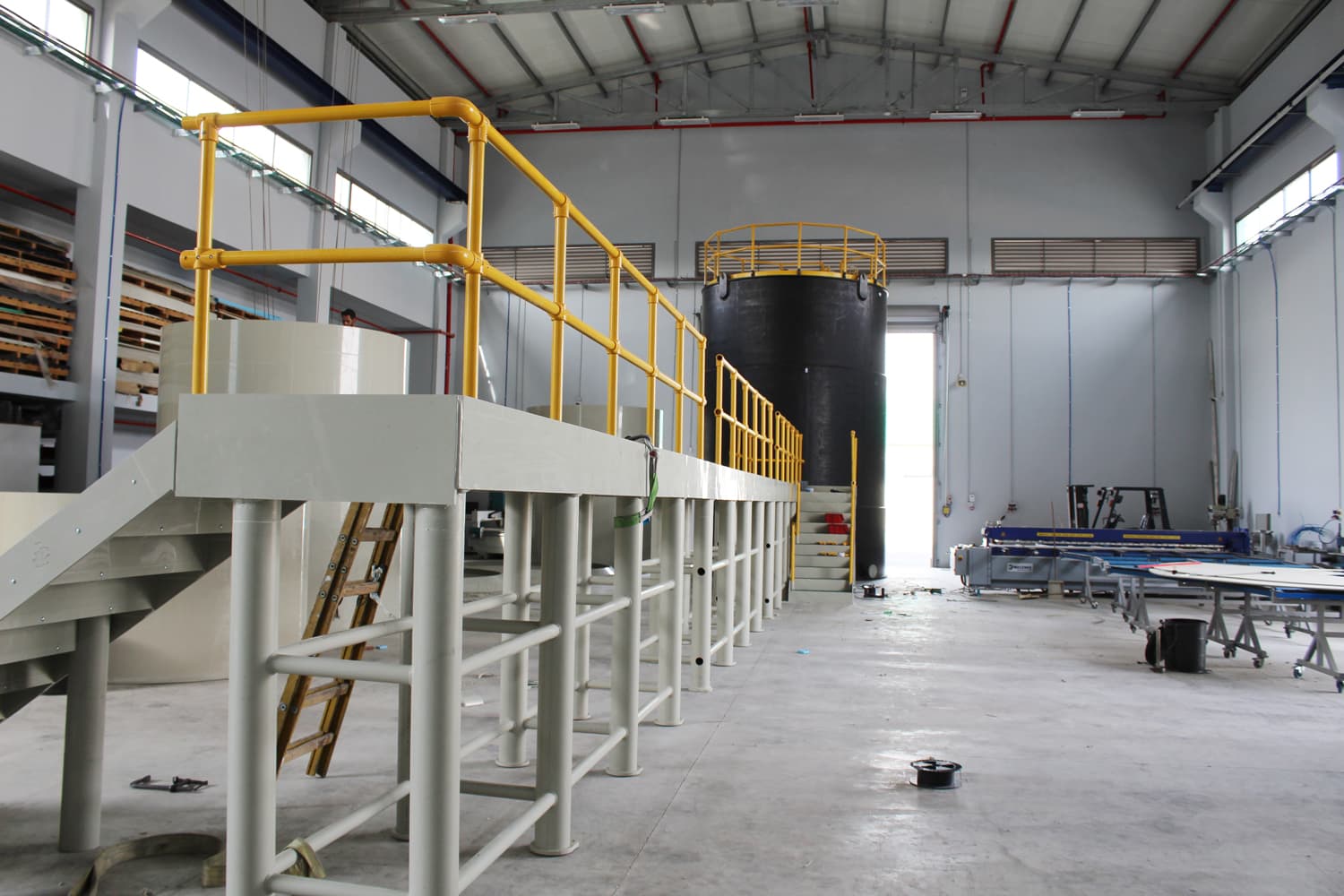


An industrial wastewater pretreatment line runs on three vessels: an equalization tank that smooths the flow, a neutralization tank that brings pH back into range, and a containment basin that catches a leak. Each one carries a different load, so each one is built from a different material.
At Plast Hen, the demanding vessel of the three is the acid neutralization tank, because its wall meets acid and base in turn and also the heat the reaction itself releases. A tank specified from the effluent analysis alone can fail even when the specification looks correct.
Who owns the process and who owns the tanks
Industrial wastewater treatment splits into two worlds. There is the process - which technology, DAF or settling, aerobic or anaerobic, and which reagent - and that belongs to process engineers and environmental consultants. And there is the equipment the process runs inside: the tanks, the piping and the containment.
Plast Hen is the second half. We do not design the process and we do not sell it; we manufacture and install the industrial plastic tanks and piping the process runs inside.
We come into projects both as a subcontractor to process companies and directly with the plant. This article is about that half of the job - which is also the half that tends to stay vague in the specification.
Three tanks, three different requirements
Three vessels recur in an industrial wastewater pretreatment plant, and they are easy to confuse. The equalization tank smooths, the neutralization tank corrects, and the containment basin is not part of the process at all.
| Vessel | Function | What the wall meets | What decides the material |
|---|---|---|---|
| Equalization tank | Smooths flow rate and composition | Diluted, continuous stream | Average composition and temperature |
| Neutralization tank | Returns pH to range | Both pH extremes, plus heat generated inside | The reagent, its concentration and the mixing |
| Containment basin | Contains a leak | Full-strength contents, briefly | The spill scenario |
What "in range" means is set by the receiving authority. In the United States, 40 CFR 403.5(b)(2) prohibits discharge below pH 5.0 outright, and local POTW permits commonly narrow that to 6.0-9.0. That band, not the incoming pH, is what the tank has to deliver.
The distinction is not semantic. A specification that writes "plastic tank" for all three produces a plant that works until the first event outside the average.
 If a specification says equalization tank without stating whether it means water recirculation or wastewater pretreatment, clarify before ordering - these are two different products
When both functions sit in the same tank
In many specifications this vessel appears as a combined equalization and pH adjustment tank, and sometimes both functions genuinely do sit in it. That is an accepted configuration, and often the right one when space is limited.
It does change the material calculation. A combined tank is evaluated against the stricter of the two duties rather than the average between them - meaning against the pH extremes and the heat the dosing generates, not against the diluted stream that enters it.
Why is neutralization the demanding stage?
pH correction sounds like the simple step in the plant, and in practice it is the opposite. The first reason is exposure to both extremes: a tank handling both an acidic and an alkaline stream meets strong acid and strong base in turn.
A material that stands up well to one does not necessarily stand up to the other, and a choice made on the dominant stream shows its limits on the secondary one.
The second reason is almost always forgotten: neutralization is an exothermic reaction. When the reagent is dosed at high concentration, the heat raises the temperature above that of the incoming stream; in a dilute stream it is negligible.
So the wall has to withstand the temperature generated inside, not the one measured at the inlet. The concentration at which the reagent is dosed is a design input, not a technical footnote.
Why the heat concentrates in one spot
In a poorly mixed tank, the reagent does not disperse; it overdoses locally around the injection point, and the wall there sees a pH well outside the one on the datasheet - with whatever heat that reaction releases on top. At high concentrations this is controlled through dosing rate, pH probe placement and mixing, not through wall thickness alone.
Those three - dosing rate, probe placement and mixing - are design decisions, not installation details. What we ask you to send before we issue a recommendation is a different list, and it is set out in the questions below.
A note on naming: the same vessel appears in specifications as an acid neutralization tank, a pH neutralization tank or an effluent treatment tank, and the effluent wording is the common one in Commonwealth usage. They describe the same duty.
Which reagent, and why it reaches the wall
Caustic soda is the common alkaline reagent because it is fast and easy to dose, but it is also the one that generates the most heat per unit and the one that pushes PVDF to its limit. Lime is slower and cheaper and runs cooler, at the cost of sludge handling. CO2 cannot overshoot past neutral at all, which removes the reagent-side heat spike but limits how far down it can pull an alkaline stream.
The reagent is therefore not only a process choice. It sets the temperature the wall sees and the pH extreme it has to survive.
What decides the material?
For acidic streams and demanding mixtures, polypropylene is our default, because it holds a higher service temperature. Against bases, the two polyolefins are comparable; what PP buys you is the top of the temperature envelope, roughly 95 °C (203 °F) against 60 °C (140 °F) for PE 100.
Chemical-resistant tanks are not one category. In general, chemical resistance: PP and HDPE are close, and against some oxidizers, HDPE is actually the better choice; what decides it at the neutralization stage is the heat. We covered polypropylene tanks and their properties on a separate page.
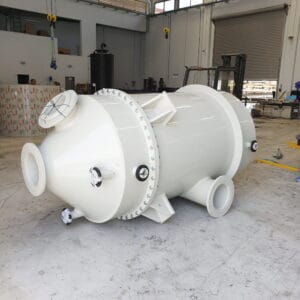
Where the stream is unusually aggressive - metal plating wastewater treatment with concentrated acids, chlorinated solvents, or a plating stream that has to be segregated - we move up to PVDF and ECTFE. Of the two, PVDF is the one built into a self-supporting tank wall; ECTFE normally reaches a tank as a lining, and no supplier we know of sells a free-standing ECTFE vessel.
Perfluorinated polymers such as PFA resist more still, but their flexural modulus is roughly a third that of PVDF, which rules them out as a structure at tank scale. They too are used as a lining - which is exactly the logic behind an armored FRP tank with an internal liner, where the FRP carries the load and the liner carries the chemistry.
The difference between the two matters most at the neutralization stage. PVDF is highly resistant to acids and oxidizers, but concentrated caustic soda attacks it chemically by dehydrofluorination, and the wall discolors and embrittles rather than simply cracking. Arkema rates its PVDF homopolymer to about pH 12 and Kynar Flex to 13.5, so the alkaline side is where the polymer choice is decided.
So when the alkaline reagent is concentrated, ECTFE is the right choice of the two. The same consideration applies upstream, to the caustic soda storage tank that feeds the dosing line.
The same ECTFE choice appears in the armored chemical waste collection tank we built for Shapir at the Port of Ashdod - a cylindrical glass-fiber-reinforced FRP vessel with a continuous internal ECTFE lining, intended to prevent contaminants from reaching the groundwater.
| Material | Service temperature | Where it stops | Role in the tank |
|---|---|---|---|
| HDPE | up to ~60 °C (140 °F) | Heat, before chemistry | Self-supporting wall |
| PP | up to ~95 °C (203 °F) | Strong oxidizers | Self-supporting wall |
| PVDF | Above PP | Alkaline side, ~pH 12 | Self-supporting wall |
| ECTFE | Above PP | Mechanical strength | Lining inside FRP |
| PFA | Above PVDF | Stiffness, ~1/3 of PVDF | Lining only |
When is HDPE the right choice, and when is it not?
HDPE tanks are excellent for water, wastewater and drainage. The limitation that matters here is service temperature, which is lower than that of polypropylene. For sodium hypochlorite, by contrast, HDPE is normally the better rated of the two polyolefins - there the question is material grade and antioxidant package, not a move to a different polymer.
In a neutral stream at ambient temperature, HDPE is the right choice; in a tank where neutralization takes place, and the stream heats up, temperature is what rules it out. The full comparison is in PP vs HDPE vs PVC vs PVDF vs FRP.
None of this changes with size. What does not decide the material is volume. A 5 m³ (1,300 gal) wastewater storage tank and a 50 m³ (13,200 gal) wastewater treatment tank on the same stream are made from the same polymer; what changes is wall thickness and reinforcement, derived by calculation under DVS 2205. We work to it, and to an ISO 9001 quality system. What each standard actually covers is set out in quality standards for plastic tanks.
Two different products called a balance tank
An equalization tank in wastewater treatment - the eq tank, in plant shorthand - smooths flow rate and composition: it absorbs the hit of a CIP wash or a batch emptied all at once, and releases downstream at a steady rate. It also dilutes.
The same name is used for a different vessel entirely - a balance tank in a closed water recirculation system, as in public swimming pools and filtration plants. There the job is holding level against evaporation and bather load, and the adversary is chlorine and humidity rather than acid.
Containment is not treatment
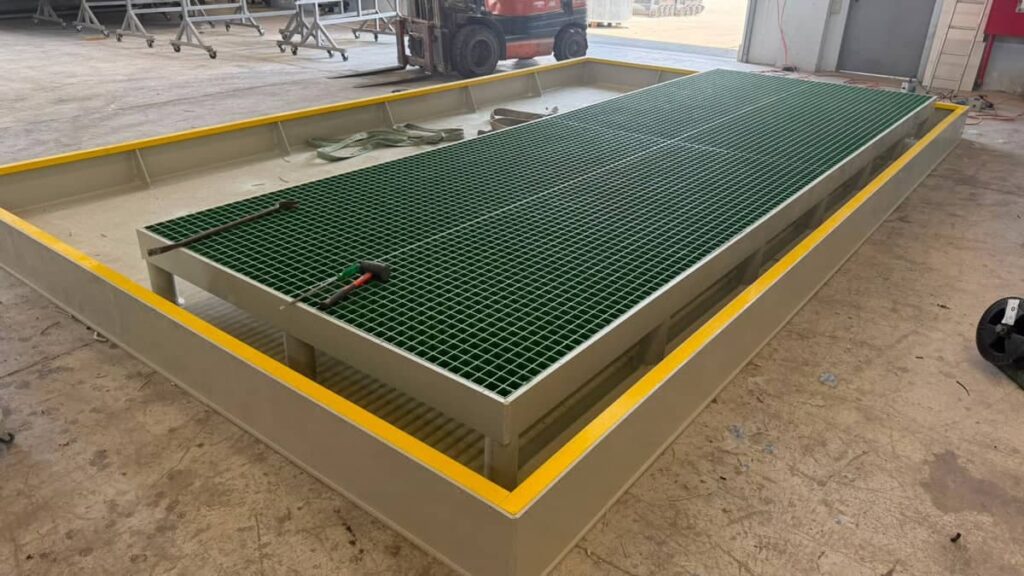
A containment basin sits under or around the tank, and its only job is to hold the contents if the tank leaks, so the material does not reach the soil and the groundwater. A retention basin is the same idea at larger scale.
Sizing follows the same logic. We build containment to 110% of the tank volume, which is the common design rule and leaves freeboard above a full release rather than exactly matching it.
That distinction changes the material requirement, and not in the direction most people expect. The tank meets the stream as it is in operation, sometimes diluted; the basin meets the contents at full strength. So the basin sometimes needs a more resistant material than the tank above it - we set out that choice in containment basins for hazardous materials.
The piping into and out of the tank
The stream reaches the tanks and leaves them through piping, and the piping meets that same stream under conditions that are sometimes worse, because there is no volume to disperse heat and no dilution. Material selection for piping, welding methods and certifications are covered in industrial piping contractors.
In our projects the tank and the piping are engineered together. A joint between two materials that were not designed for each other is the first failure point, and also the place where responsibility blurs between suppliers.
Alongside material compatibility, your connection specification needs to account for the forces and moments transmitted by the pipework. The guide to tank wall piping loads explains how supports, flexibility, anchoring and reinforcement fit into that review.
Water and wastewater projects we have delivered
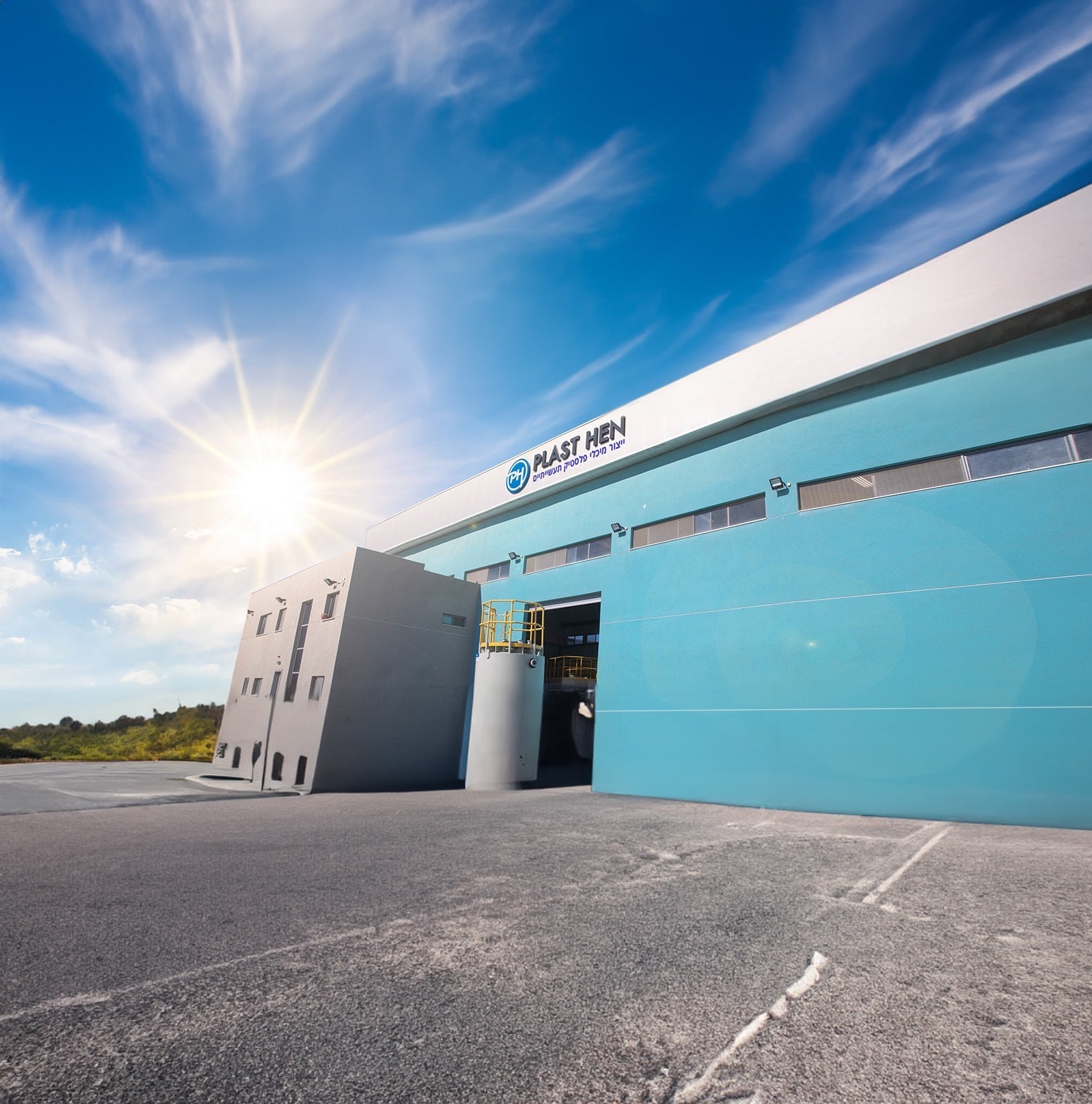
Plast Hen has manufactured thermoplastic tanks and piping from our plant in Be'er Sheva, in the Negev, since 1993. In water and wastewater we have delivered, among others:
- Agricultural wastewater treatment system - manufacture and installation
- PP process reactors for IDE at the Sorek desalination plant
- Acid pool mixing system at Adama Makhteshim
- Armored chemical waste collection tank with ECTFE lining for Shapir at the Port of Ashdod
- 130 m³ (34,300 gal) HDPE tank for a food plant - not wastewater, but the same wall calculation at that volume
- Three settler tanks of 60 m³ (15,900 gal) each for Rotem Amfert - engineered to a chemical separation and filtration process
Three of these are water or wastewater plants in the direct sense, and the rest are the same engineering on a different stream.
Thermoplastic is not the answer in every case, and we say so up front. Where unusual mechanical strength is needed at large diameters, or where high heat and high pressure arrive together, fiberglass or a composite solution may suit better - and sometimes lined metal. We say that at the proposal stage.
With your first enquiry send the analysis with maximum values rather than averages - that is the figure that prevents a wrong specificationWhat to check before ordering a tank
A wastewater tank fails when it is specified for the stream rather than for the reaction. Equalization smooths and meets a diluted stream; neutralization corrects and meets both pH extremes plus heat generated inside; containment holds and is judged against full strength.
Specify all three on one line and you get a plant that works until the first abnormal event. We are glad to go through the analysis with you and say what fits, including the cases where the answer is not thermoplastic.