



The Environmental Challenge in the Chemical Industry
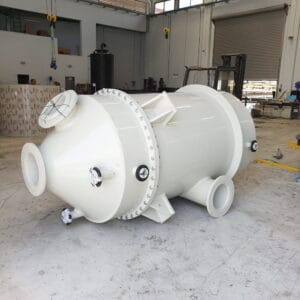
The chemical industry in Israel and worldwide faces increasingly stringent regulatory oversight regarding air pollutant emissions. Plants are required to invest growing resources in technologies to reduce their ecological footprint. Scrubbers and Absorption Columns represent one of the most central and effective solutions for reducing pollutant emissions and meeting strict environmental standards.
Data from the Ministry of Environmental Protection shows that plants that have installed advanced scrubber systems have succeeded in reducing pollutant emissions by 85%-98%, depending on the type of pollutant and technology implemented. This investment not only prevents heavy fines but also improves the company's image and promotes corporate responsibility and sustainability strategies.
Operating Principles: The Chemistry and Physics Behind the Technology
Wet Scrubbers
Wet scrubbers operate on a sophisticated physicochemical principle of mass transfer between phases. The contaminated gas stream is directed through a tower where it comes into contact with an absorbent liquid in various forms:
- Spray Tower Scrubbers - The liquid is sprayed as fine droplets against the rising gas stream
- Packed Tower Scrubbers - The gas passes through a porous medium that is continuously wetted
- Tray Tower Scrubbers - The gas passes through layers of trays containing liquid
- Venturi Scrubbers - The gas undergoes acceleration through a narrow throat to create intensive turbulence with the liquid
The efficiency of a scrubber depends on several key parameters. The contact time between the gas and liquid is a critical factor, with longer contact allowing for better absorption. The surface area of contact between phases plays a crucial role - the larger the contact area, the higher the efficiency. The solubility of the pollutant in the absorbent liquid largely determines the absorption potential, with water-soluble materials like SO₂ and HCl being absorbed more efficiently. The composition of the absorbent liquid is specially tailored to the type of pollutant, with basic solutions used for acidic gases and acidic solutions for basic gases. Temperature and pressure also directly affect the absorption rate and overall system efficiency.
Absorption Columns
Absorption columns are essentially an advanced type of scrubbers, with a tall vertical structure that allows particularly efficient contact between phases. The key to their efficiency lies in the special packing materials that increase the available surface area. Absorption columns use two main types of packing materials: random packing, including elements such as Raschig rings, Berl saddles, and Pall rings, distributed in an unorganized manner within the column; and structured packing consisting of metal or plastic sheets folded in complex geometric patterns, allowing optimal flow of gas and liquid. In modern absorption columns, the surface area to volume ratio can reach 250-500 m²/m³, enabling particularly efficient absorption even for pollutants that are more difficult to treat.
Complementary Separation Systems: Ensuring Emission Quality
Demisters - Advanced Technologies
Demisters are critical for achieving high emission quality and protecting downstream equipment. The main technologies include:
- Mesh Pads - Layers of mesh made of metal wires or polymers, with a density of 30-200 wires per inch. Droplets are captured on the wires and coalesce until their weight causes them to fall back.
- Vane Separators - A series of specially shaped vanes that cause the gas stream to change direction sharply. Inertia causes droplets to separate from the gas stream and drain.
- Centrifugal Separators - Based on rotation of the gas stream, where centrifugal force separates the droplets.
- Electrostatic Demisters - Advanced technology using an electric field to charge droplets and divert them to collection electrodes.
The separation efficiency of modern demisters can reach 99.9% for droplets of 5 microns and above, and about 95% for smaller droplets (1-5 microns).
Cyclones - Efficient Particle Removal
Cyclones serve as an essential preliminary stage in gas treatment systems. Their advanced operating principle is based on the gas stream entering at an angle to a conical chamber, creating a spiral motion. Solid particles and large droplets accelerate outward due to centrifugal force, meet the cyclone wall, and slide downward to the collection area. The efficiency of a cyclone system depends on several critical design parameters, such as the ratio of the cyclone body diameter to the upper gas outlet diameter, gas inlet velocity (optimal between 15-27 m/sec), inlet angle and spiral geometry, and the length of the conical and cylindrical sections.
The industry uses two main types of cyclones: large single cyclones (Single Cyclones) and multi-cyclone systems (Multi-cyclones) composed of several small cyclones in parallel. Cyclones are particularly effective in separating particles of 5-10 microns and above, with efficiency that can reach 90%. For smaller particles (1-5 microns), efficiency drops to 50-80%.
System Integration: Designing an Optimal Treatment System
Combining Technologies for Maximum Efficiency
Designing an optimal gas treatment system requires a holistic view and a deep understanding of pollutant characteristics. A complete treatment system typically includes the following components in this order:
- Pre-treatment - Systems for cooling the gas and removing large particles (cyclone, electrostatic precipitator)
- Main treatment stage - Scrubbers and absorption columns for neutralizing polluting gases
- Finishing stage - Demisters for removing residual moisture and fine particles
- Control and monitoring systems - Sensors and controllers for real-time process optimization
Case Study: Integrated System in an Israeli Chemical Plant
A fertilizer manufacturing plant in southern Israel installed an integrated system for treating pollutant emissions. The system includes an advanced pre-treatment system with dual cyclones for initial separation of large particles, an absorption column with structured polypropylene packing resistant to corrosion, and a basic solution injection system with automatic pH control for efficient neutralization of acidic gases. Additionally, the system is equipped with a vane-type demister combined with a fine mesh screen, and a continuous monitoring system measuring emission concentrations in real-time. The impressive results of the system include a 97% reduction in nitrogen oxide and ammonia emissions, full compliance with the most stringent emission standards, and a rapid return on investment within less than two years, thanks to the prevention of fines and pollution levies.
Specific Applications in the Israeli Chemical Industry
Tailored Solutions for Different Industry Sectors
Fertilizer and Agrochemical Industry
- Challenge: Emissions of ammonia, nitrogen oxides, and phosphoric acid
- Solution: Two-stage scrubbers with acidic absorption solutions (H₂SO₄) for ammonia neutralization
- Performance: Ammonia absorption efficiency of 99.5% and above
Chlor-Alkali Industry
- Challenge: Emissions of chlorine (Cl₂) and hydrogen chloride (HCl)
- Solution: Absorption columns with NaOH solution at 10-15% concentration
- Chemical reaction: Cl₂ + 2NaOH → NaOCl + NaCl + H₂O
- Performance: Reduction of chlorine emissions to only 1-3 ppm
Pharmaceutical Industry
- Challenge: Vapors of organic solvents (VOCs) and volatile organic compounds
- Solution: Scrubbers with selective organic solvents or activated carbon
- Performance: 95% reduction in VOC emissions
Coatings and Paints Industry
- Challenge: Complex mixture of solvents and paint particles
- Solution: Integrated system of cyclone, venturi scrubber, and demister
- Performance: Compliance with the stringent German TA-Luft standard
Standards, Regulation, and Regulatory Requirements in Israel
Legal and Regulatory Framework
In Israel, the requirements for installing scrubber systems are anchored in several mandatory regulatory frameworks. The Clean Air Law, enacted in 2008, provides the basic framework, requiring any plant dealing with chemical substances to take significant measures to reduce pollutant emissions to the air. Additionally, the Ministry of Environmental Protection issues individual emission permits for each plant, including specific requirements according to the nature of the activity and environmental risks. BAT (Best Available Technology) standards require plants to implement the best technology available from a technical and economic perspective, with these standards being updated frequently. There are also specific emission standards setting maximum threshold values for various pollutants, with non-compliance potentially resulting in significant sanctions.
Monitoring and Maintenance Requirements
The Ministry of Environmental Protection imposes stringent requirements regarding the monitoring and maintenance of gas treatment systems. In many cases, installation of CEMS (Continuous Emission Monitoring Systems) is required for continuous emission monitoring. Concurrently, periodic stack sampling tests are required at least once a year by an accredited laboratory to ensure compliance with standards. All activity must be meticulously documented, with a requirement to submit quarterly reports detailing the performance of treatment systems. A documented preventive maintenance program is also required, including systematic replacement of components at regular intervals according to the manufacturer's instructions. The Ministry of Environmental Protection takes non-compliance with these requirements seriously, and penalties can reach fines of up to 2.5 million NIS, administrative closure orders, and even criminal liability for company managers.
Economic and Environmental Considerations
Cost-Benefit Analysis
Investing in a quality scrubber system represents a strategic decision with significant economic implications. The costs involved include an initial setup cost ranging from 0.5-3 million NIS, depending on the size and type of system required. Additionally, there are ongoing operational costs including electricity consumption, water, chemicals, and routine maintenance, amounting to approximately 10-15% of the setup cost annually. On the other hand, the economic benefits typically outweigh the costs: prevention of fines and pollution levies can save hundreds of thousands of shekels annually, new systems are more energy-efficient and economical in resource consumption, and in many cases, the absorbed materials can be returned to the production process. Beyond this, improving the company's environmental image and relations with the surrounding community represents a value that is difficult to quantify but of increasing business importance in an era of environmental awareness. Research shows that the average return on investment in quality scrubber systems stands at 2-4 years, making them a worthwhile investment from a long-term economic perspective.
Innovative Technologies and Future Trends
Innovation and Current Developments
- Bio-scrubbers - Using microorganisms to break down organic pollutants
- Membrane Scrubbers - Increasing the efficiency of contact between phases
- Hybrid Systems - Combining scrubbers with technologies such as UV or catalysis
- IoT Systems for Monitoring and Control - Smart sensors and remote control for real-time optimization
- Modular Scrubbers - Systems that can be easily expanded according to changing needs
Case Studies of Successful Projects in Israel
The Israeli industry presents several impressive case studies of implementing advanced technologies in the field. At a pharmaceutical plant in central Israel, which faced the challenge of organic solvent emissions from drug manufacturing processes, an innovative hybrid system combining a cryogenic scrubber with activated carbon was installed. The project results showed an impressive 99.2% reduction in VOC emissions, with a rapid return on investment within just 30 months. At a chemical company in the Haifa area, which dealt with emissions of sulfuric acid and sulfur oxides, a two-stage scrubber system was implemented with automatic pH control and an IoT system for continuous monitoring. The system not only led to compliance with the most stringent standards but also resulted in a 40% saving in chemical consumption, making the project worthwhile from both an economic and environmental perspective.
Maintenance and Optimization: Ensuring Performance Over Time
Best Maintenance Practices
- Routine Maintenance:
- Daily checking of pressures, flow rates, and temperatures
- Cleaning of filters and demisters once a week
- Checking pH and scrubber liquid quality daily
- Periodic Maintenance:
- Thorough cleaning of packing materials once a quarter
- Replacement of seals and valves once a year
- Checking for wear and corrosion in critical parts
- Preventive Maintenance:
- Analysis of performance data to identify negative trends
- Proactive replacement of components before failure
- Planned upgrading of components according to technological developments
Advanced Optimization and Monitoring
Using innovative technologies enables significant improvement in the performance of gas treatment systems over time. Adaptive control systems allow automatic adjustment of operating parameters according to changing process conditions, ensuring optimal performance at all times. Advanced analytics techniques leverage the wealth of collected data to identify patterns and optimize the process, continuously improving efficiency and saving resources. The predictive maintenance approach represents a significant leap forward, using advanced algorithms to predict failures before they occur, reducing downtime and extending system life. Together, these technologies allow plants to get the most out of their gas treatment systems while ensuring continuous compliance with regulatory requirements.
Conclusion: The Future of Emission Treatment in the Chemical Industry
Scrubbers, absorption columns, and complementary separation systems are much more than a technical solution to regulatory requirements - they represent a comprehensive approach to environmental responsibility and sustainability in the chemical industry. The combination of advanced technologies, precise design, and proper maintenance allows chemical plants to continue their industrial activity while minimizing environmental impact.
Leading Israeli companies in the field offering advanced solutions include Plast-Chen, Alchem Industries, Technoplast, and Arad Technologies, providing quality local solutions that meet the most stringent international standards.
In an era of growing environmental awareness and global warming, investing in quality gas treatment systems is not just a regulatory requirement but also a wise business decision and an investment in the future of the Israeli industry.